
On Democracy, Problem-Solving, and What We're Trading Away

There’s a story unfolding right now that isn’t really about gun violence prevention—or rather, it’s not only about that. It’s about something more fundamental: how democracies actually work versus how authoritarian systems operate.
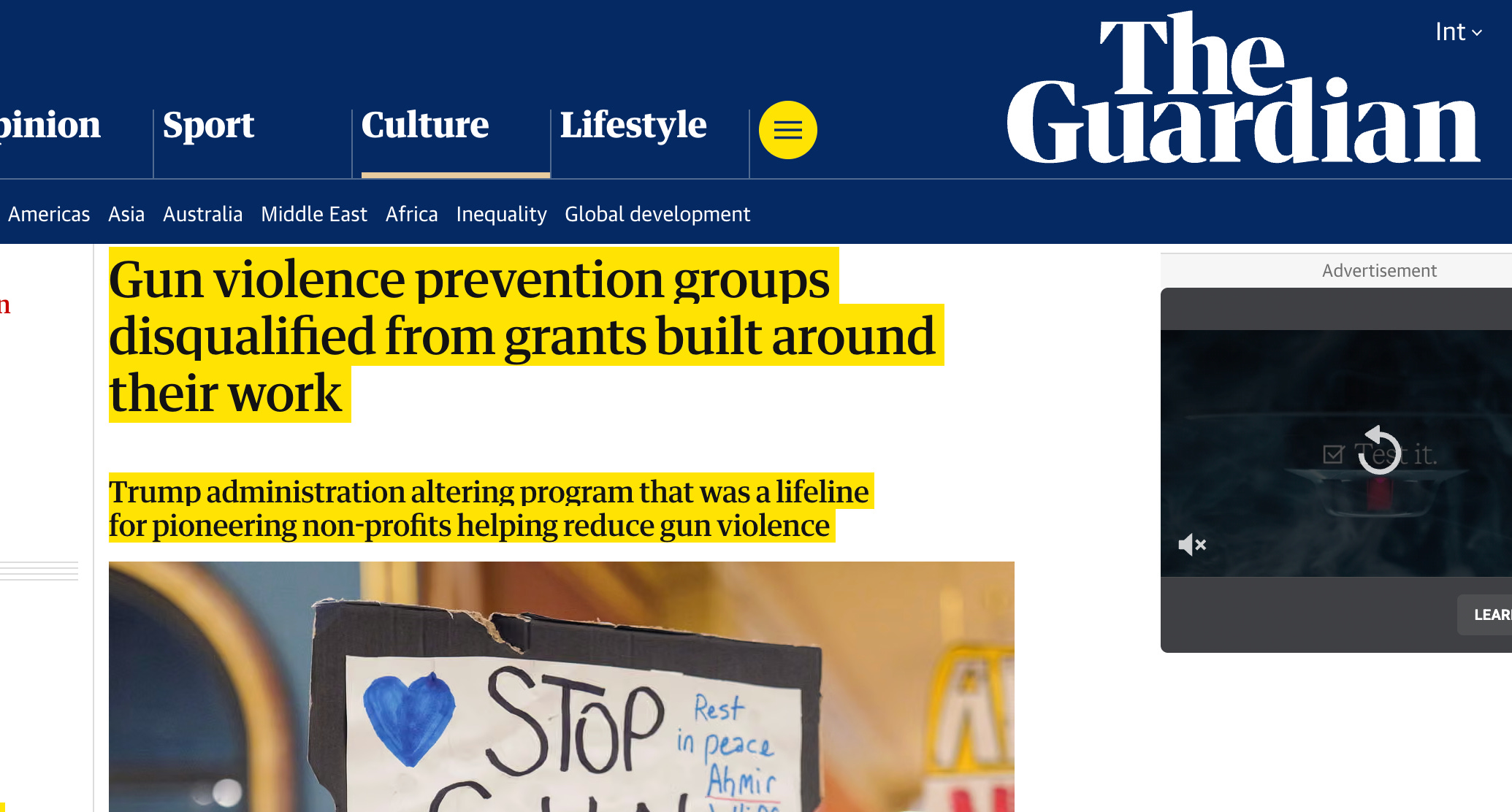
The Trump administration just restructured a federal grant program (CVIPI) that was funding community organizations to reduce gun violence. These weren’t random groups—they were people from the neighborhoods most affected by violence, doing the difficult work of intervening before shots are fired. People like the ones who rush to hospital bedsides after shootings, who know which conflicts are about to turn deadly, who can walk into situations where police presence would only escalate tensions.
The program was working. Cities where these groups operated saw declining homicides. But now? Those organizations are disqualified. Only law enforcement can apply.
Here’s what this reveals about two different philosophies of governance:
Democracy thrives on diversity of approach. It says: this problem is complex, so let’s fund the community organizers AND the police AND the researchers AND the social workers. Let’s see what works. Let’s let people closest to the problem try solutions. It’s messy. It’s inefficient. It involves a lot of people we might not personally trust or agree with. But it creates resilience—when one approach fails, others are still working.
Authoritarianism demands centralized control. It says: there’s one right way, one legitimate authority. We’ll decide who’s qualified. We’ll control the solution. It’s cleaner. More orderly. And when you agree with that authority’s goals, it can feel satisfying—finally, someone’s taking charge!
But here’s the thing about centralized control: it doesn’t stop where you want it to.
When government says “only police can address violence,” it’s not just excluding community groups. It’s establishing a principle: that state force is the only legitimate response to social problems. Today it’s violence prevention. What about tomorrow? Mental health crises? Homelessness? Protests? School discipline? Family disputes?
Are you ready for what that actually looks like?
Not theoretically—practically. In your neighborhood. In your kids’ lives. Because once you establish that only one institution, answerable only to executive power, gets to define and solve problems, you’ve traded away something essential: the ability of communities to shape their own solutions.
Maybe you’re comfortable with that trade. Maybe you trust that the people in charge will always align with your values, will always use that power wisely, will never turn it on communities or causes you care about.
But I’d ask you to consider: the groups being defunded right now were working. They were reducing homicides. They were supported by local communities who wanted them there. And they’re being eliminated not because they failed, but because they exist outside the chain of command.
That should concern you regardless of your politics. Not because these specific organizations are perfect, but because the principle at stake—that diverse, decentralized approaches to public problems are illegitimate—doesn’t stop with programs you don’t care about.
Now let’s talk about what comes next: privatization.
This administration has been crystal clear about one thing: private companies should have more control over public functions, not less. We’ve seen it with education, infrastructure, healthcare—and we’re seeing it with public safety.
So ask yourself: what happens when your personal control becomes a profit center for policing companies?
What might they do to increase their profits?
Think about how private prisons make money—they need beds filled. Private probation companies profit from extending supervision. Ankle monitor companies bill by the day. Red light camera companies get paid per ticket. Private security firms need contracts renewed.
When taking away your rights becomes something companies can profit from, what do you think happens to your rights?
When all that matters is quarterly earnings and shareholder returns, what might privatized public safety companies do that you didn’t plan for? Lobby for harsher penalties? Lower the threshold for intervention? Find new behaviors to criminalize? Extend monitoring periods? Make it harder to get off supervision? Increase fees that keep people trapped in the system?
Pay attention to the pattern: this administration is showing us that private companies should be given more control over our lives, not less. So it will apply here too. Public safety will become someone’s profit margin.
Just make sure you understand how people who want to make more money make decisions.
I am 100% sure it has very little to do with ensuring your own freedoms and opportunity.
Because here’s the brutal truth: a community violence prevention worker succeeds when violence goes down. They win by working themselves out of a job. But a private contractor? They succeed when their services are needed more, not less. The incentives point in completely opposite directions.
Community organizations want to solve the problem. Private companies want to manage it—profitably, sustainably, indefinitely.
So which system do you want responding to your kid’s mental health crisis? Your neighbor’s dispute? Your community’s problems?
Democracy is inefficient. It means funding approaches you think are wrong. It means letting communities choose solutions you wouldn’t choose. It means accepting that there’s no single right answer to complex problems.
But that inefficiency is a feature, not a bug. It’s what prevents any one faction from gaining total control. It’s what ensures that when your community faces a crisis, you have options beyond waiting for the state—or a corporation—to decide what’s best for you.
You don’t have to love community violence intervention programs to recognize what’s being lost here. You just have to ask yourself: in the long run, do I want to live in a system that tolerates different approaches to problems, or one that demands I trust a single authority to always get it right? And do I want that authority accountable to voters, or to shareholders?
Your kids will inherit whichever answer we choose.
References: https://www.theguardian.com/us-news/2025/oct/26/gun-violence-prevention-non-profit-grants-disqualified?utm_term=68fe2970315a5cb523e1bb3ec00f8319&utm_campaign=GuardianTodayUS&utm_source=esp&utm_medium=Email&CMP=GTUS_email
What we’re seeing is a coordinated shift toward centralized control of public-safety alongside a new willingness to put the federal government on the capitalization table of “strategic” finance in the US (watch the govt acquisitions underway). That mix plus expanding privatized control over the coercive tools Leisa mentioned pushes the system toward state-managed markets and away from community-driven problem-solving.
As for the CVIPI, community-based nonprofits can still participate, but only as sub-recipients. Notable in the new OJP NOFO is that it also adds award conditions referencing compliance with 8 U.S.C. 1373, which revives immigration-related participation with DHS. This will eliminate the participation of many police and sheriff’s departments.
Police officials don’t have all the answers to safety and countering violence. They never have and they never will. No matter how excellently investigations and enforcement bring shooters to justice, it doesn’t stop those who may choose to be a shooter.
Multidisciplinary community safety leadership is always a better effort. For communities, especially with those at highest risk, to be safer, we should decentralize solutions and de-financialize coercion, not concentrate them.