
The Process Is the Punishment
A reflecting pool, a Friday night dismissal, and the machinery that makes the correction arrive too late to matter.

Here is how the story goes.
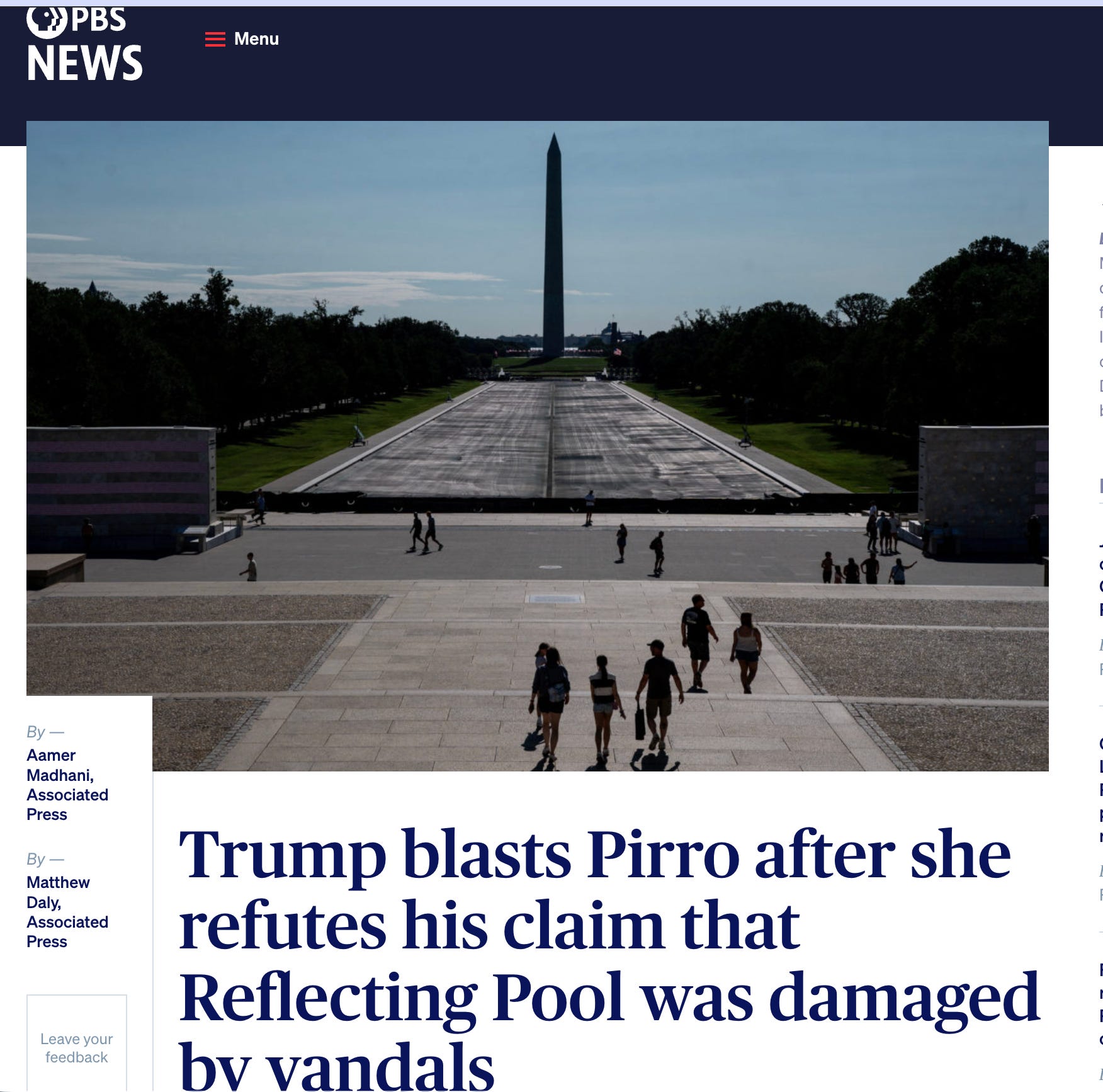
Something happens. A pool is renovated in a hurry, on a no-bid contract, for a number that starts at 1.8 million dollars and climbs past 14 million. The water turns green. The paint peels. This is a failure, and failures have authors.
Then something is made up about it. The authors do not want to be the authors. So a story appears. Not a contractor story. A vandal story. “Radical Left SCUM” with sharp knives and muscle, cutting a 350 foot gash into the night. A 67 year old former Olympian who reached into the water on a bike ride is arrested and charged with destruction of public property.
Then it plays out. Slowly. Over weeks, over months. Officials go on television and insist the vandals are real. They promise photographs that never arrive. And then, on a Friday night, in the quietest hour the news cycle allows, the Department of Justice moves to dismiss. The filing admits what the critics said from the first day. Flawed installation. A rushed job. No vandal at all.
Then the story is over. And this is the part worth sitting with.
Because by the time the truth arrives, no one is watching. The accusation was a headline. The correction is a footnote filed after dark. The man was arrested in June. The charges were dropped weeks later, quietly. The audience that watched him get handcuffed will never see him walk free.
The conviction was never the point
There is a name for this.
In 1979 the political scientist Malcolm Feeley studied lower criminal courts and found that the outcome of a case barely mattered to the people caught in it. What mattered was everything before the outcome. The arrest. The handcuffs. The lawyers. The money. The months of fear. He called it the process is the punishment.
You do not need a guilty verdict to punish someone. You need only the power to begin. The arrest is the sentence. The exoneration, if it comes, arrives after the sentence has already been served.
David Hearn was never going to prison. That was never the plan. The plan was to have a body to put in handcuffs, so that the failure had a villain instead of an author. He served his sentence the moment the cuffs closed. Whatever came after was just paperwork.
Who benefits
Ask who the vandal story protects and the machinery comes into focus.
It protects the people who profited from the failure. The no-bid contract went to a firm whose ultimate owner is a Trump donor, at an address that is a mansion near Mar-a-Lago. A vandal in the night means no one asks how that contract was awarded, or why the price quadrupled, or who signed off. The scapegoat launders the grift.
One man in handcuffs erases a dozen questions about the money.
It protects the fantasy. The base was told the project was a triumph. A vandal keeps that story alive. A contractor kills it.
And the public pays twice. Once for the botched work. Again for the machinery of the cover story, the arrest, the prosecution, the officials flown to television studios to defend a claim they would abandon in court.
The dividend is not really the pool. The dividend is the lesson.
The lesson is the product
Watch what the ordinary citizen absorbs from a story like this. Not the legal outcome, which they never see. The image. A man reaches into some water and is put in handcuffs. The government says he committed a serious crime. Years in jail.
The lesson lands in the body before the mind can argue with it. It can happen for nothing. It can happen to anyone. Your rights are conditional on not being chosen.
This is not confined to a pool. Phones are searched and copied at the border. People are detained without due process. United States citizens are swept up in raids and held. Some are even killed. Later, some are proven innocent. If they are lucky. But the proof arrives quietly, and the fear arrived loud, and the fear is the thing that stays.
Hannah Arendt wrote about the right to have rights. The insight was that rights are not a possession. They are a status other people agree to honor. Take away the honoring and the rights remain on paper while vanishing in fact. What these cases teach, one Friday night dismissal at a time, is that the honoring is optional. That is the product. Not the conviction. That is the conditioning.
Why the delay is not an accident
The gap between the accusation and the correction is not a flaw. It is the mechanism.
A lie travels in a single sentence. The truth requires a court, a filing, months, a reporter willing to read the docket. By the time it arrives the audience has moved on and the emotional imprint has set. Arendt saw this too. The aim of the flood of falsehood is not to make you believe any single lie. It is to wear down your ability to tell true from false, until you stop trying, and shrug, and conclude that power does what it wants and always has.
The Friday night dismissal is the final move. Announce the crime at noon on every channel. Confess the truth at midnight in a document no one will read. The imbalance is the design.
What we do with this
So what do we do, those of us who still believe in due process and freedom and the plain idea that rights should mean something.
Hold two truths at once. The harm was real. The story was false. Both. Do not collapse into denial, and do not collapse into despair. Denial says nothing happened. Despair says nothing can be done. Both are forms of surrender, and both are exactly what the conditioning is for.
Name the pattern. Once you can see the shape, arrest, fantasy, slow truth, silence, the individual instances stop disorienting you. You are not confused. You are watching a play you have seen before. Recognition is not resistance, but it is where resistance starts.
Refuse the memory hole. The correction is filed in the dark because darkness is where they want it. So drag it into the light. Say his name after the charges are dropped, not only when they are filed. Mark the dismissals. The people who were told he was guilty deserve to be told he was not.
Break the isolation. The isolation of the targeted person is the weapon. One man, alone, in handcuffs, is the whole point. Attention, legal defense, solidarity, these are not sentiment. They are the countermeasure. Hearn had a governor and two newspapers on his side. Most people have no one. Being the someone is the work.
And then there is the inner question, the one about the psyche, and here I want to be very specific. I have spent a long time in the world that says the answer to fear is to regulate your nervous system and come back to calm. Some of that is true. Fear that lives in the body unexamined hardens into the very helplessness the whole apparatus is trying to install. Steadiness is real, and it is worth practicing.
But steadiness is not compliance, and calm is not consent. The point of regulating your fear is not to make peace with the thing causing it. It is to keep your hands from shaking so you can keep doing the work. Anyone who tells you the answer to state power is purely internal, that you simply need to heal and breathe and accept what is, is selling you a sedative and calling it wisdom. The breath serves the ballot. The inner steadiness serves the outer refusal. Not the other way around.
Freedom is not a thing you own and then lose. It is a thing you practice, out loud, in public, on behalf of the person who was chosen this time and might be you the next.
Rights are the same. They live only in the honoring. So we honor them. We say the names. We read the dockets. We refuse to let the correction die on a Friday night.
They arrested a man for reaching into some water. Then they admitted there was never a crime. Do not let the second sentence disappear. The whole design depends on you forgetting it.
Did you ever write about Biden allowing millions of illegal aliens to enter the country?